How to Build a Year-Over-Year Longevity Health Dashboard
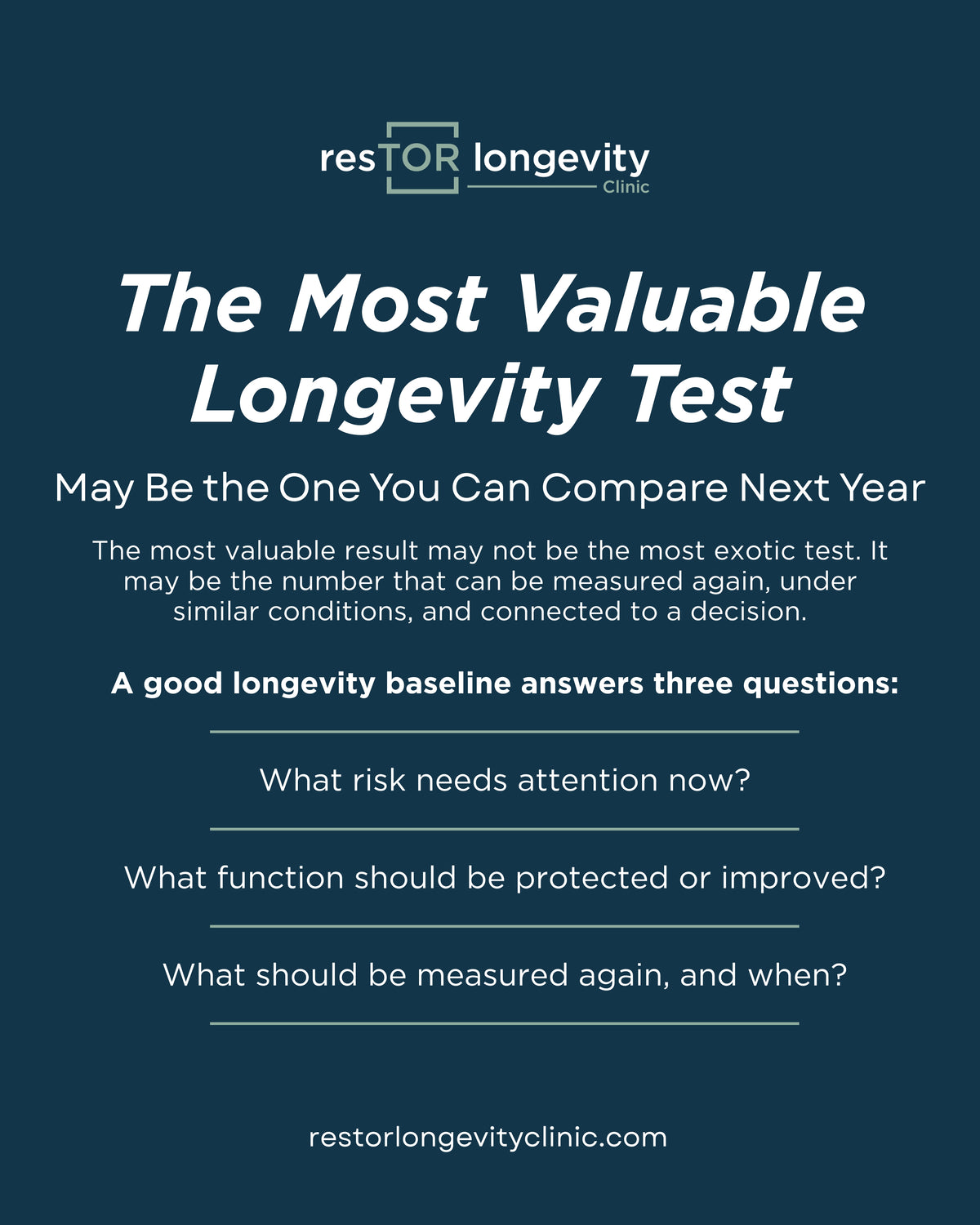
The best yearly longevity dashboard is a focused set of measures tied to personal risk and actionable goals. It may include cardiovascular, metabolic, fitness, sleep, bone, cognitive, and screening data, but each item should have a reason, a follow-up interval, and a decision it can influence.
At resTOR Longevity Clinic in Houston, Texas, Dr. Gregory Burzynski, MD, reviews this information as one part of a broader physician-guided assessment. The goal is not to chase an isolated score. It is to connect the result with cardiovascular, metabolic, cognitive, hormonal, fitness, sleep, imaging, and family-history data when those categories are relevant.
Start With Decisions, Not a Shopping List
Testing is useful when it helps decide what to prevent, what to treat, what to train, or what to monitor. Ordering every available panel can create noise, false positives, and contradictory scores.
A focused dashboard begins with age, family history, symptoms, prior diagnoses, medications, lifestyle, and goals. Those inputs determine which cardiovascular, metabolic, imaging, genetic, functional, or screening tools are appropriate.
Separate One-Time Data From Repeatable Data
Whole-genome sequencing is generally a one-time test because the DNA sequence does not change. The interpretation may evolve as science advances. Blood pressure, lipids, glucose markers, body composition, strength, fitness, and sleep can change and may need repeat measurement.
Imaging intervals depend on the modality, the initial result, radiation considerations when applicable, age, and risk. Repeating a scan simply because a year passed is not the same as clinically indicated monitoring.
Use Comparable Conditions
Trends are more believable when measurements are repeated with the same method and similar conditions. The same laboratory, device, protocol, time of day, and preparation can reduce avoidable variation.
A change should also be large enough to matter. Small fluctuations may reflect hydration, recent exercise, illness, sleep, or measurement error rather than a true shift in risk or function.
Make the Results Consultation Do Real Work
A useful review ranks findings by importance, distinguishes urgent follow-up from long-term optimization, and identifies the smallest number of priorities likely to make the biggest difference. It should also explain which normal findings are reassuring and which do not fully exclude risk.
The final plan names the action, owner, timeline, and measure of success. Without that step, advanced diagnostics remain a collection of interesting facts rather than preventive care.
Frequently Asked Questions
Do all health metrics need to be repeated every year?
No. The interval depends on the test, baseline result, risk, intervention, and clinical guideline.
Is more testing always better?
No. More testing can create false positives and noise. Each test should answer a defined question.
What if all my results are normal?
A normal baseline can still guide prevention by confirming priorities, identifying what does not need frequent testing, and creating a reference for future change.
Turn the Result Into a Plan
A useful longevity test should clarify a decision, a priority, or a trend to follow. To discuss a personalized assessment with Dr. Gregory Burzynski, MD, contact resTOR Longevity Clinic at (832) 968-7531. The clinic is located at 9432 Katy Freeway, Suite 400, Houston, Texas 77055.
This article is educational and does not replace individualized medical advice. Testing and follow-up should be selected with a qualified clinician based on personal history, symptoms, risk, and current guidelines.
Sources
- resTOR process and physician-led planning
- resTOR FAQ on baselines and follow-up
- Nature Communications framework for evidence-based precision health
Published by resTOR Longevity Clinic | Dr. Gregory Burzynski | Serving Houston and Harris County, TX | (832) 968-7531
Educational purposes only. Not medical advice.