
Why a Routine Physical May Not Tell the Whole Health Story
A routine physical is important. It can review symptoms, medical history, blood pressure, medications, recommended screening and common laboratory markers. But many adults leave an annual visit with a different question: How well is my body actually functioning as I age?
That question is broader than whether a basic lab panel falls inside a reference range. At resTOR Longevity Clinic in Houston, Dr. Greg Burzynski, MD, uses physician-guided testing to examine multiple dimensions of health when clinically appropriate, including cardiovascular fitness, body composition, metabolic health, physical function and other individualized risk information.
A physical and a longevity assessment answer different questions
Routine preventive care is designed to identify health concerns, manage known conditions and keep recommended screening current. A longevity assessment can add a different layer by establishing measurable baselines and looking at systems that routine testing may not quantify.
For example, body weight does not reveal how much weight comes from fat or lean tissue. A standard blood panel does not measure cardiorespiratory fitness. Normal resting vital signs do not show how the body performs under exertion.
None of that makes routine care inadequate. It means different tools answer different questions.
What can a deeper assessment measure?
Depending on the individual and program, resTOR's assessment model can incorporate advanced blood testing, DEXA body composition, VO2 max, cardiovascular testing, metabolic assessments, genetics and other diagnostics. The clinic describes its process as a comprehensive evaluation followed by physician review and a personalized plan.
The key word is context. A measurement is most useful when there is a reason to obtain it and a plan for interpreting it.
More testing is not automatically better medicine
It is easy to assume that the longest test menu must be the most comprehensive. That is not necessarily true. Every test has strengths, limitations and a specific clinical purpose.
Broad testing can also uncover unexpected findings that require follow-up. The American College of Radiology, for example, has cautioned that total-body MRI screening in asymptomatic people without relevant risk factors can identify nonspecific findings and lead to additional testing. That does not make advanced imaging inherently good or bad. It makes patient selection and interpretation important.
The American College of Radiology explains its position on total-body MRI screening.
Why baselines matter
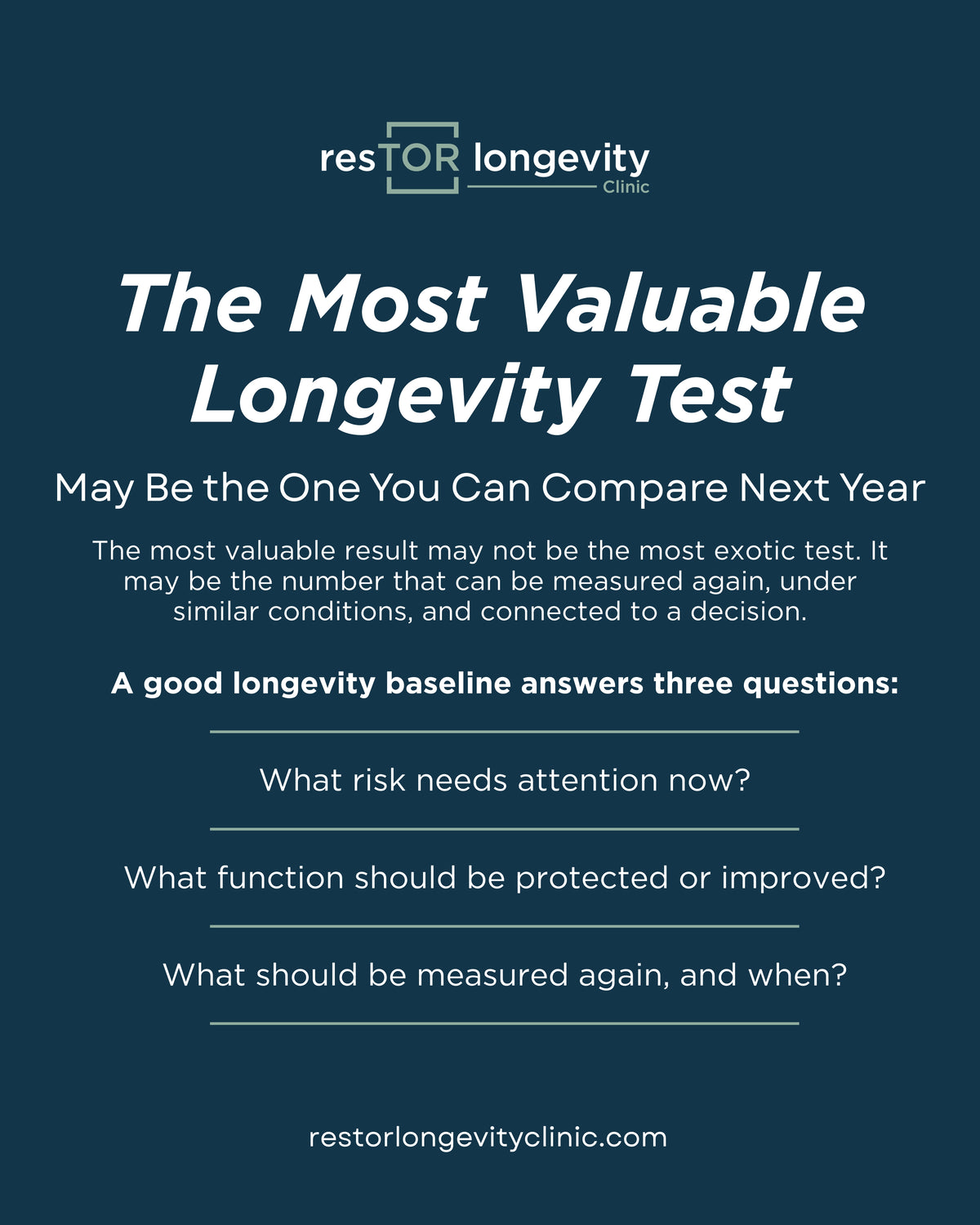
A baseline creates a point of comparison. One DEXA scan describes body composition at one moment. A later scan can help show whether lean mass or fat mass changed. One VO2 max test measures current cardiorespiratory fitness. A future measurement can help evaluate whether a training strategy changed functional capacity.
This is one reason longitudinal information can be more useful than chasing a single perfect number. The question becomes not only, “Is this normal?” but also, “What direction is this moving?”
Dr. Greg Burzynski connects the pieces
resTOR Longevity Clinic is designed around a physician-led interpretation model. Dr. Greg Burzynski, MD, reviews health information in relation to the individual rather than treating every result as a separate story.
That matters because cardiovascular health, metabolism, sleep, body composition, strength and other systems interact. A useful plan should recognize those relationships.
For adults who want a more detailed baseline, the goal is not to collect every number available. It is to identify information that can clarify risk, function and priorities.
Learn more about resTOR Longevity Clinic's physician-guided programs or review how the resTOR assessment process works.
Published by resTOR Longevity Clinic | Dr. Gregory Burzynski | Serving Houston and Harris County, TX | (832) 968-7735
Educational purposes only. Not medical advice.