Mobility Training for Strength, Balance, and Healthy Aging
Mobility affects nearly every movement you make, from reaching overhead and bending down to walking comfortably and getting up from a chair. It is often confused with flexibility, but the two are not exactly the same.
Flexibility describes how far a muscle can stretch. Mobility refers to your ability to move a joint through its available range of motion with strength, stability, and control. Both matter, but mobility is especially important for maintaining physical capability as you age.
At resTOR Longevity Clinic in Houston, Dr. Gregory Burzynski and the resTOR team consider movement quality alongside strength, body composition, cardiovascular fitness, recovery, and other longevity markers. Patients from Houston and nearby Pearland may benefit from understanding where movement restrictions could be affecting exercise performance or daily comfort.
Why Does Mobility Matter for Healthy Aging?
Mobility supports your ability to move safely and confidently. When the hips, ankles, shoulders, or spine become stiff, the body may begin compensating in other areas. These changes can affect posture, walking mechanics, balance, and exercise technique.
For example, limited ankle mobility may make it more difficult to squat or walk up stairs comfortably. Restricted hip movement may affect stride length and lower-body control. Reduced movement through the upper back can place more strain on the shoulders or lower back.
Mobility can also influence how easily you perform everyday activities, including:
• Reaching overhead or behind your body
• Getting up from the floor or a low chair
• Walking, climbing stairs, or stepping over obstacles
• Turning to look behind you
• Exercising with proper form and control
Maintaining these abilities can support independence and make it easier to stay physically active. Mobility exercises cannot prevent every injury, but improving movement quality may reduce unnecessary strain and help the body handle activity more efficiently.
“Mobility work should help people move with more confidence, not leave them feeling like they have to force their body into uncomfortable positions. The goal is better control and function that carries into daily life,” says Dr. Gregory Burzynski.
What Exercises Can Help Improve Mobility?
The most useful mobility exercises depend on the joints involved, your current movement ability, and any pain or previous injuries. A routine should be gradual and controlled rather than aggressive.
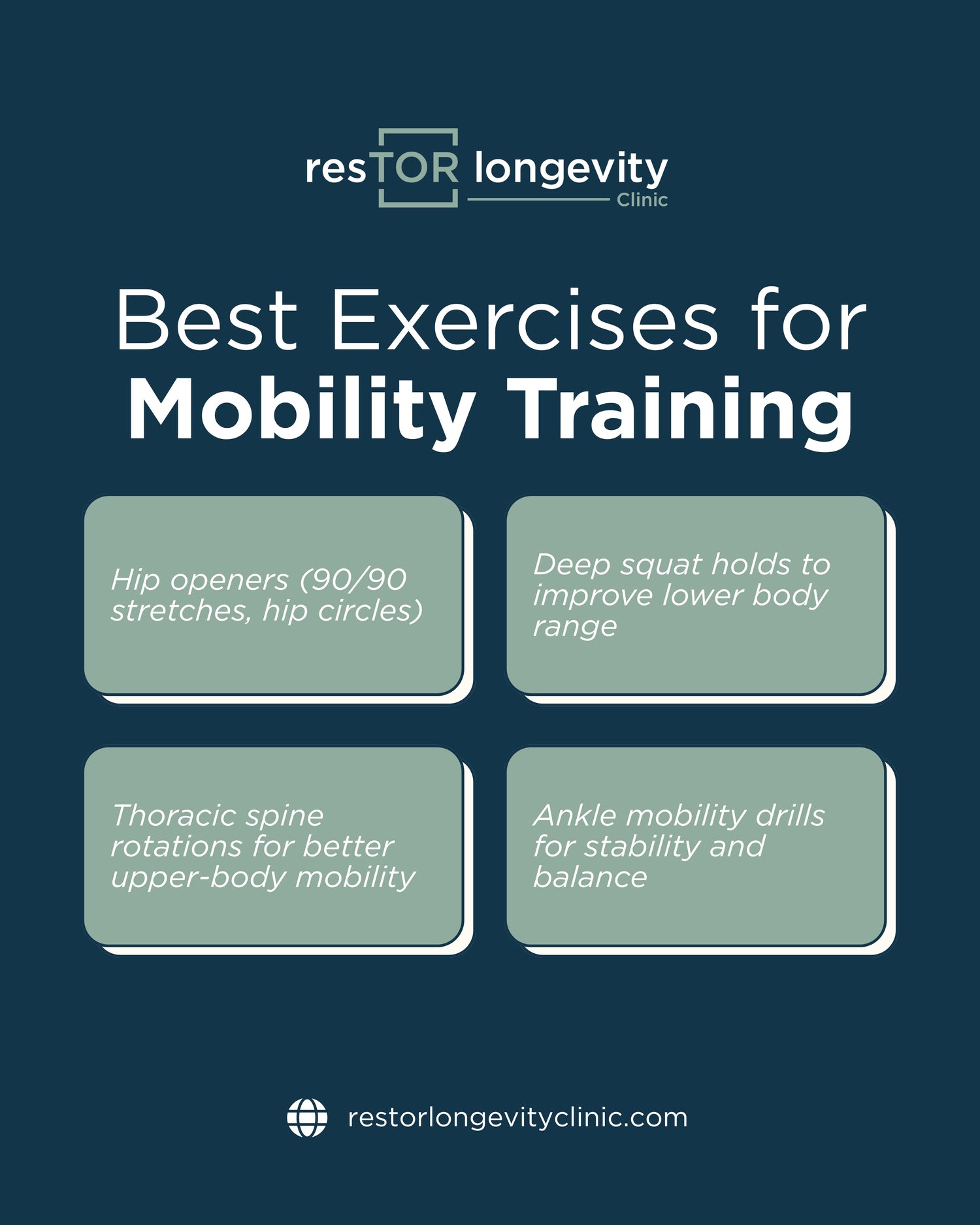
Common mobility exercises include:
• Hip circles or 90/90 movements to explore hip rotation
• Supported deep squat holds for ankle, hip, and lower-body mobility
• Thoracic spine rotations to improve upper-back movement
• Ankle rocks or calf stretches to support balance and walking mechanics
• Controlled lunges with rotation to combine stability and movement
Dynamic stretches can also be useful before exercise. Leg swings, arm circles, walking lunges, and gentle movement flows gradually prepare the joints and muscles for activity. Longer static stretches may be more appropriate after exercise or during a separate mobility session.
Quality matters more than the number of repetitions. Movements should remain slow enough that you can maintain control and notice where stiffness or compensation begins. Sharp pain, numbness, or joint instability are signs to stop and seek appropriate evaluation.
Building Mobility Into Your Routine
Mobility training does not need to take an hour. A short routine practiced consistently may be more helpful than an occasional long session. Even five to ten minutes can be enough to focus on areas that feel restricted.
You might include mobility work:
• During a warmup before strength or cardiovascular exercise
• After sitting for long periods
• On recovery days between harder workouts
• Before activities that require balance or coordination
• As part of a morning or evening routine
Mobility should also be supported by strength. Gaining range of motion without developing control in that range may not improve function. Strength exercises such as squats, lunges, carries, rows, and presses can reinforce mobility when they are performed with appropriate technique and resistance.
Balance exercises may also be helpful, especially as part of a healthy aging plan. Standing on one leg near a stable surface, practicing controlled step-ups, or walking in different directions can challenge coordination and stability.
Movement Quality Is Only One Part of the Picture
Stiffness or reduced mobility can develop for many reasons. Inactivity, repetitive movement patterns, previous injuries, muscle weakness, joint changes, pain, and poor recovery may all contribute.
Sleep, nutrition, hydration, stress, and training volume can also affect how the body feels and recovers. Someone who is consistently sore or fatigued may need more than additional stretching. Their routine may require changes in exercise intensity, recovery time, or overall health support.
At resTOR Longevity Clinic, movement can be reviewed as part of a broader assessment of physical performance and long-term health. Looking at mobility alongside muscle mass, cardiovascular fitness, metabolism, and personal health history can provide a clearer understanding of what may be limiting progress.
Stay Capable as You Age
Mobility training can support better movement, balance, strength, and confidence throughout life. The goal is not to achieve extreme flexibility. It is to maintain the control and range of motion needed to exercise, complete daily tasks, and remain independent.
Contact us to Learn More About Movement Quality
Published by resTOR Longevity Clinic | Dr. Gregory Burzynski | Serving Houston and Harris County, TX | (832) 968-7531
Educational purposes only. Not medical advice.