AI Whole-Body MRI Screening: Benefits, Limits, and Incidental Findings
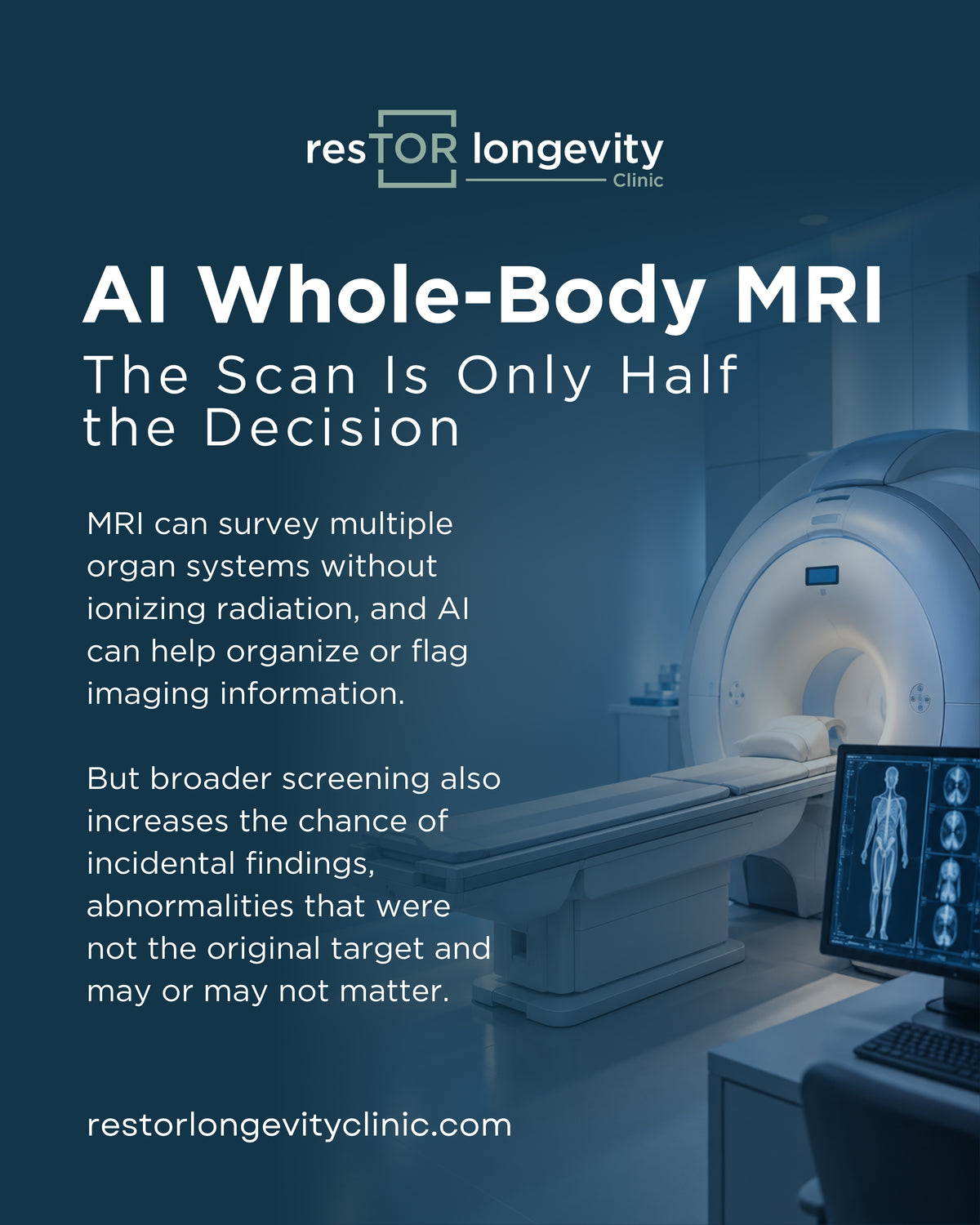
Whole-body MRI can survey multiple organ systems without ionizing radiation, but it can also identify incidental findings that may require more imaging or procedures. It should not be presented as a universal replacement for guideline-based screening, and its value depends on patient selection, expert interpretation, and a clear follow-up pathway.
At resTOR Longevity Clinic in Houston, Texas, Dr. Gregory Burzynski, MD, reviews this information as one part of a broader physician-guided assessment. The goal is not to chase an isolated score. It is to connect the result with cardiovascular, metabolic, cognitive, hormonal, fitness, sleep, imaging, and family-history data when those categories are relevant.
What Whole-Body MRI Can Offer
MRI uses magnetic fields and radio waves rather than ionizing radiation. A whole-body protocol can create images across several regions in one session, which is why the technology attracts interest from people seeking a broad preventive baseline.
Artificial intelligence may assist with image reconstruction, segmentation, measurement, or prioritization. The exact role depends on the platform, and AI output still requires appropriate human review. The phrase AI-powered should not be treated as a guarantee of accuracy or improved outcomes.
The Incidental Finding Problem
When imaging covers more anatomy, it is more likely to show something unrelated to the original reason for scanning. Many incidental findings are benign, but some are uncertain and lead to repeat imaging, specialist consultations, biopsy, cost, or anxiety.
This does not make broad imaging inherently wrong. It means informed consent should include the possibility of ambiguous results. A responsible program must define who reviews findings, how urgency is determined, and where follow-up occurs.
Why Guidelines Remain Cautious
The American College of Radiology has stated that evidence is insufficient to recommend total-body MRI screening for every asymptomatic person without symptoms, risk factors, or relevant family history. It also notes that cost-effectiveness and life-prolonging benefit have not been established for universal screening.
A cautious guideline does not mean the technology has no possible role. It means selection matters, and marketing should not get ahead of evidence. Personal risk, prior findings, genetics, age, and the ability to complete follow-up can change the decision.
What to Ask Before Booking a Scan
Ask which body regions and sequences are included, who interprets the images, whether contrast is used, how false positives and incidental findings are handled, and how results interact with standard screening. Ask whether prior images can be compared and whether the program has a defined referral pathway.
A normal MRI should not cancel mammography, colonoscopy, cervical screening, low-dose lung CT for eligible adults, dermatologic evaluation, or symptom-based care. Different tests are designed to answer different questions.
Frequently Asked Questions
Does whole-body MRI use radiation?
MRI does not use ionizing radiation. That does not make every scan necessary or every finding meaningful.
Can a normal whole-body MRI rule out cancer?
No. No imaging protocol detects every cancer, and a normal scan does not replace standard screening or evaluation of symptoms.
What is an incidental finding?
It is an unexpected abnormality discovered while imaging for another purpose. It may be harmless, significant, or uncertain until further evaluation.
Turn the Result Into a Plan
A useful longevity test should clarify a decision, a priority, or a trend to follow. To discuss a personalized assessment with Dr. Gregory Burzynski, MD, contact resTOR Longevity Clinic at (832) 968-7531. The clinic is located at 9432 Katy Freeway, Suite 400, Houston, Texas 77055.
This article is educational and does not replace individualized medical advice. Testing and follow-up should be selected with a qualified clinician based on personal history, symptoms, risk, and current guidelines.
Sources
- American College of Radiology statement on total-body MRI screening
- resTOR FAQ on whole-body MRI and cancer assessment
Published by resTOR Longevity Clinic | Dr. Gregory Burzynski | Serving Houston and Harris County, TX | (832) 968-7531
Educational purposes only. Not medical advice.