What Does Whole Genome Sequencing Actually Test For?
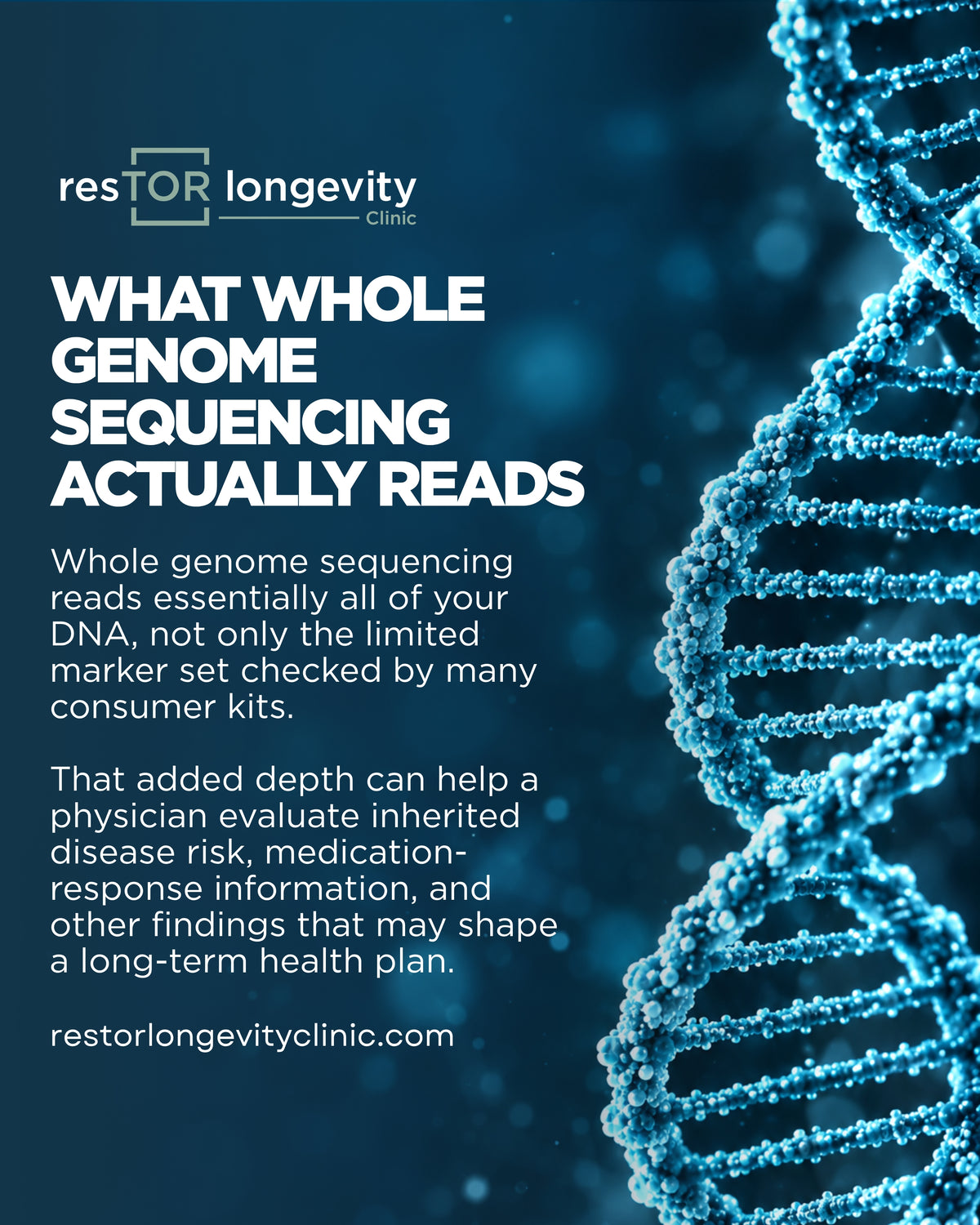
Whole genome sequencing reads essentially all of your DNA, roughly three billion base pairs, rather than the limited set of markers a consumer ancestry kit checks. That is the practical difference: one samples known spots, the other maps the whole code.
At resTOR Longevity Clinic in Houston, Texas, whole genome sequencing is used as the genetic foundation of a longevity assessment, with results interpreted by Dr. Gregory Burzynski, MD rather than handed over as a raw data file.
How Whole Genome Sequencing Differs From a Consumer DNA Kit
A direct to consumer test typically uses genotyping, which checks a few hundred thousand preselected positions in the genome. It is fast and inexpensive because it looks only where it already expects to find something.
Whole genome sequencing reads the sequence itself, including regions a genotyping array never examines. That matters because clinically meaningful variants are not always in the commonly tested spots.
- Genotyping checks known markers, sequencing reads the underlying code
- Sequencing can identify rarer variants an array would miss entirely
- Sequenced data can be reexamined later as genetic science advances
- Clinical sequencing is interpreted by a physician, not an app
What the Results Can Inform
Genetic information is most useful when it changes a decision. In a longevity setting, sequencing generally informs three kinds of decisions: what to screen for, when to start screening, and how to approach certain medications.
Inherited risk is the most familiar category. Variants associated with certain cancers, cardiovascular conditions, and metabolic disorders can shift both the timing and the frequency of monitoring.
Medication response is the second. Some genetic differences influence how the body processes particular drug classes, which can be useful context for a physician making prescribing decisions.
The third is context for everything else in the assessment. A genome does not exist in isolation, and it reads very differently next to current bloodwork and imaging.
Why a Genetic Result Is Not a Verdict
Carrying a variant associated with a condition is not the same as having that condition, or being certain to develop it. Most of what shapes long-term health involves how genetics interacts with sleep, metabolism, activity, environment, and time.
That is the reason sequencing belongs inside a broader evaluation rather than standing alone. Individual results, risk levels, and appropriate next steps vary from patient to patient.
Used well, a genome narrows the field. It tells a physician which questions deserve attention first, which is a very different thing from telling you what will happen.
Where Sequencing Fits in the resTOR Assessment
Whole genome sequencing is one component of the comprehensive evaluation offered through the personalized resTOR longevity program. It is reviewed alongside imaging, cardiovascular testing, metabolic markers, and hormone results.
Patients begin with a physician-led planning conversation, complete their assessment, and then sit down for a results consultation. That sequence is described in more detail on the resTOR process page.
Members traveling in from Memorial, Spring Branch, and the surrounding Houston area typically complete their testing in a single scheduled day.
Questions Worth Asking Before You Sequence
Genetic testing is personal, and it is reasonable to think about it before committing. A few questions tend to clarify things quickly.
- Who will interpret these results, and are they a physician?
- Will the findings actually change my screening schedule?
- How is my genetic data stored and protected?
- What happens if something unexpected turns up?
Frequently Asked Questions
Is whole genome sequencing the same as a 23andMe test?
No. Consumer kits typically use genotyping, which checks a few hundred thousand selected markers. Whole genome sequencing reads the full sequence, including regions those arrays do not examine. The two produce very different levels of detail and are interpreted differently.
Do I need to repeat whole genome sequencing over time?
Generally no. Your genome does not change, so the sequence itself is a one time test. What changes is scientific understanding, which means existing data can be reexamined later as new associations are established.
Will my results tell me how long I will live?
No. Sequencing identifies inherited variants associated with certain conditions, not a lifespan. Outcomes depend on many factors beyond genetics, and how any individual responds to monitoring or treatment varies.
Start With a Conversation
If you want to understand your genetic baseline with physician guidance, resTOR Longevity Clinic in Houston, Texas can explain what sequencing does and does not answer. Contact resTOR Longevity Clinic or call (832) 968-7531 to schedule an initial consultation with Dr. Gregory Burzynski, MD.
Sources
This article is educational and does not replace individualized medical advice or genetic counseling.
Published by resTOR Longevity Clinic | Dr. Gregory Burzynski | Serving Houston and Harris County, TX | (832) 968-7531
Educational purposes only. Not medical advice.