
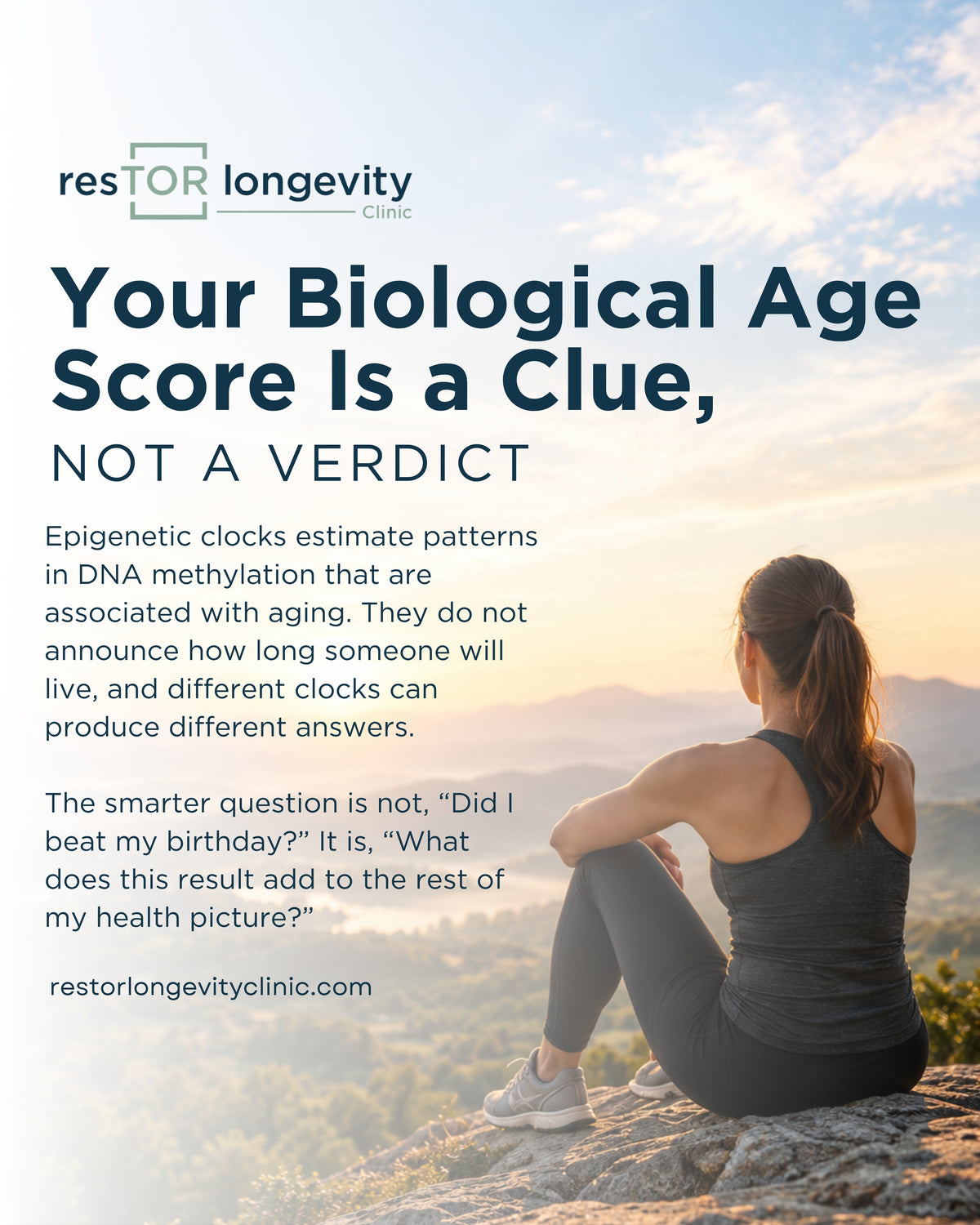
What Does a Biological Age Test Actually Tell You?
A biological age test estimates age-related changes in the body, often through DNA methylation patterns. It may add useful context, especially when repeated consistently, but it cannot predict an exact lifespan, diagnose disease by itself, or replace standard clinical testing.
At resTOR Longevity Clinic in Houston, Texas, Dr. Gregory Burzynski, MD, reviews this information as one part of a broader physician-guided assessment. The goal is not to chase an isolated score. It is to connect the result with cardiovascular, metabolic, cognitive, hormonal, fitness, sleep, imaging, and family-history data when those categories are relevant.
What an Epigenetic Clock Measures
Epigenetics refers to chemical changes that help regulate how genes are used without changing the underlying DNA sequence. Many commercial biological age tests focus on DNA methylation, small chemical tags that appear in patterns associated with age and health exposures.
A clock is an algorithm built from selected methylation sites and a reference population. Because clocks are designed for different purposes, two tests can estimate different ages from the same person. That disagreement does not automatically mean one laboratory made an error. It may mean the models are measuring different aspects of aging.
Why One Number Needs Clinical Context
A lower estimate can feel reassuring and a higher estimate can feel alarming, but neither should be interpreted alone. Acute illness, smoking, metabolic dysfunction, inflammation, medications, and technical differences can influence results. A score also cannot reveal whether a specific artery contains plaque, whether bone density is declining, or whether a cancer screening is due.
The practical value increases when the result is compared with conventional markers and functional measures. Blood pressure, lipids, glucose regulation, body composition, cardiorespiratory fitness, strength, sleep, and guideline-based screening remain important because each answers a different question.
Trend Matters More Than a Competition
Biological age is often marketed as a contest against chronological age. Clinically, a consistent method repeated over time may be more informative than a single dramatic result. The testing conditions, laboratory, and clock should remain as consistent as possible before drawing conclusions from change.
Even then, improvement in a clock should be interpreted together with outcomes that matter in daily life, such as strength, stamina, sleep quality, blood pressure, and metabolic control. A better-looking algorithmic score is not a substitute for better function or lower disease risk.
The Question Every Longevity Test Should Answer
Before ordering a test, ask what decision could change because of the result. A useful answer might involve intensifying cardiovascular prevention, improving sleep consistency, addressing insulin resistance, or measuring progress after a structured intervention.
If the result will not change monitoring, treatment, behavior, or a follow-up plan, it may create information without direction. Physician review helps separate an interesting biomarker from an actionable one.
Frequently Asked Questions
Can a biological age test tell me how long I will live?
No. It estimates selected biological patterns associated with aging. It does not calculate an individual expiration date or guarantee future health.
Can biological age change?
Some epigenetic measures can change over time, but the meaning of a change depends on the clock, testing consistency, and whether other health measures changed with it.
Is biological age the same as fitness age?
No. Biological age tests may use molecular data, while fitness age estimates are usually based on measures such as cardiorespiratory fitness. They answer different questions.
Turn the Result Into a Plan
A useful longevity test should clarify a decision, a priority, or a trend to follow. To discuss a personalized assessment with Dr. Gregory Burzynski, MD, contact resTOR Longevity Clinic at (832) 968-7531. The clinic is located at 9432 Katy Freeway, Suite 400, Houston, Texas 77055.
This article is educational and does not replace individualized medical advice. Testing and follow-up should be selected with a qualified clinician based on personal history, symptoms, risk, and current guidelines.
Sources
- National Institute on Aging overview of epigenetic clocks
- NIA report on epigenetic age and health outcomes
Published by resTOR Longevity Clinic | Dr. Gregory Burzynski | Serving Houston and Harris County, TX | (832) 968-7531
Educational purposes only. Not medical advice.