Why Is Hearing Loss Linked to Cognitive Decline?
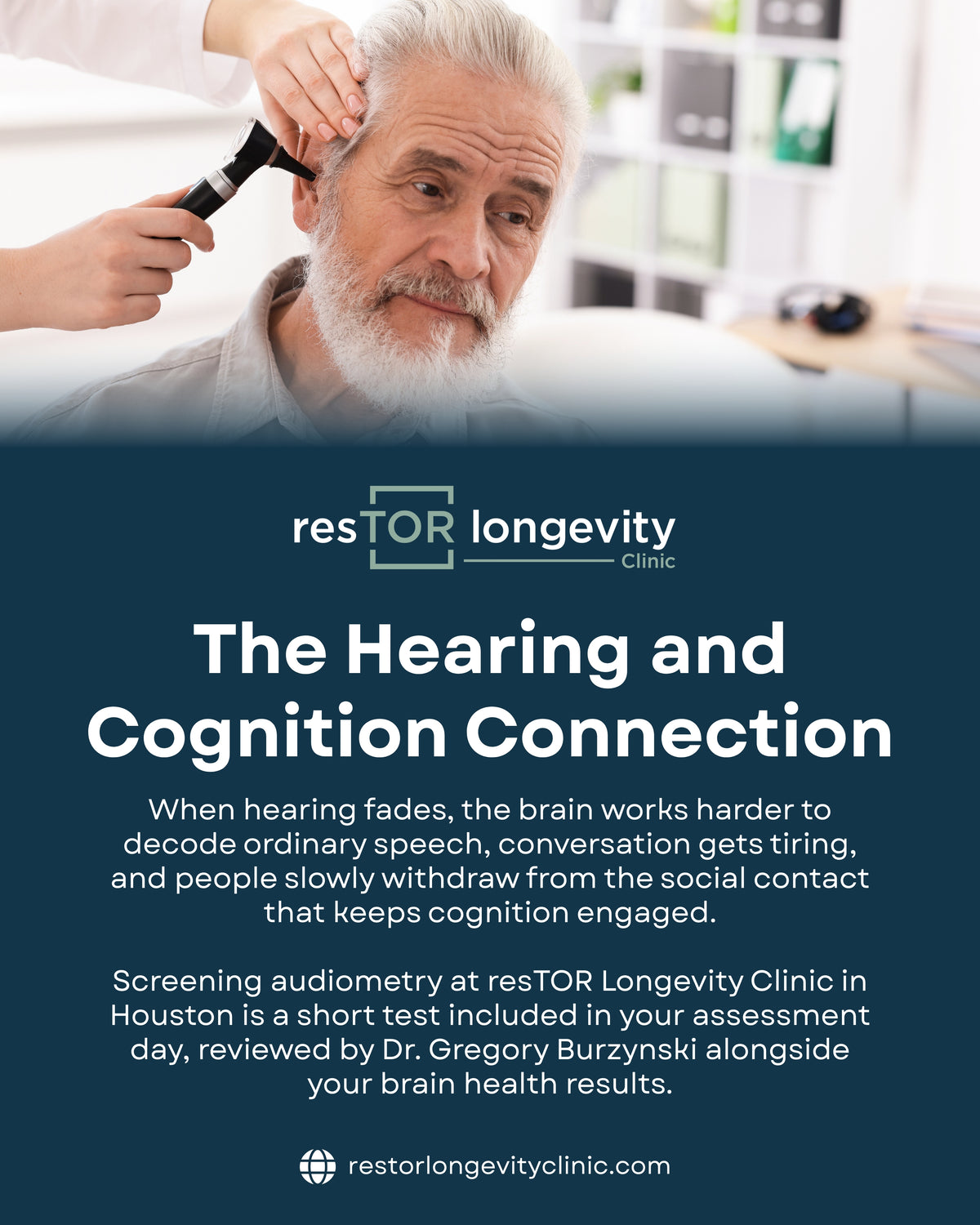
Hearing loss is consistently identified as one of the most modifiable risk factors associated with cognitive decline. The leading explanations involve increased cognitive load during listening, reduced auditory input to the brain, and the social withdrawal that untreated hearing loss tends to produce.
At resTOR Longevity Clinic in Houston, Texas, screening audiometry is included in the assessment day for exactly that reason.
How the Connection Is Understood
Researchers generally describe three overlapping mechanisms, and they are not mutually exclusive.
The first is cognitive load. When sound arrives degraded, the brain devotes more resources to decoding speech, leaving less available for comprehension and memory of what was said.
The second is reduced input. Auditory regions of the brain receive less stimulation over time, and structural changes have been observed in association with prolonged hearing loss.
The third, and possibly the most consequential, is social. Conversation becomes effortful, group settings become unpleasant, and people gradually opt out of the social engagement that supports cognitive health.
Why It Goes Unnoticed for So Long
Age related hearing loss develops slowly and usually affects higher frequencies first, which is where much of the clarity of speech lives.
- Volume can seem adequate while clarity has quietly declined
- Restaurants and group conversations become disproportionately difficult
- Family members usually notice before the person does
- The gradual pace means there is no obvious moment it began
People commonly report years between first noticing difficulty and having a hearing test.
What Screening Audiometry Involves
Screening audiometry is a short, non invasive test conducted with headphones in a quiet setting. Tones are presented at different frequencies and volumes, and you indicate what you can detect.
The result is an audiogram showing your hearing thresholds across the frequency range, which is far more informative than a subjective sense of whether you hear well.
A screening result identifies whether further audiology evaluation is warranted rather than serving as a complete diagnostic workup.
Why It Belongs Alongside Brain Health Testing
Hearing and cognition are usually handled by different specialties, which means the connection between them often goes unexamined in ordinary care.
Reviewing audiometry alongside brain health assessment, cardiovascular results, and sleep data puts a modifiable factor in front of the physician at the same time as the risk it relates to.
Addressing hearing loss is not a guaranteed protective measure against cognitive decline, and research is ongoing. It is, however, one of the more actionable items in the conversation.
Where It Sits at resTOR
Screening audiometry is included in the assessment day within the Core and Essential programs, alongside the multi-modal brain health assessment and at home sleep apnea testing.
Dr. Gregory Burzynski, MD reviews these together during the consultation described on the resTOR process page. Patients from Bellaire, Spring Branch, and across Houston complete testing in a single day.
"Hearing is one of the few items on a brain health list that has a straightforward intervention attached. It is also the one patients are most likely to have postponed for a decade," says Dr. Gregory Burzynski, MD.
Frequently Asked Questions
Will hearing aids prevent dementia?
No treatment prevents dementia, and research on hearing intervention and cognitive outcomes is ongoing. Addressing hearing loss is generally considered worthwhile for communication, social engagement, and quality of life regardless of what future research concludes.
At what age should hearing be screened?
Because age related hearing loss develops gradually, establishing a baseline in midlife is reasonable rather than waiting until difficulty is obvious. Anyone noticing trouble in restaurants or group settings has good reason to test sooner.
What happens if the screening finds something?
A screening result indicating possible hearing loss is typically followed by referral to an audiologist for full diagnostic evaluation. The screening identifies whether that next step is warranted.
Add Hearing to the Brain Health Conversation
If you have started turning the volume up or dreading noisy restaurants, that is worth measuring rather than adapting around. Contact resTOR Longevity Clinic in Houston, Texas to schedule a consultation.
Published by resTOR Longevity Clinic | Dr. Gregory Burzynski | Serving Houston and Harris County, TX | (832) 968-7531
Educational purposes only. Not medical advice.