
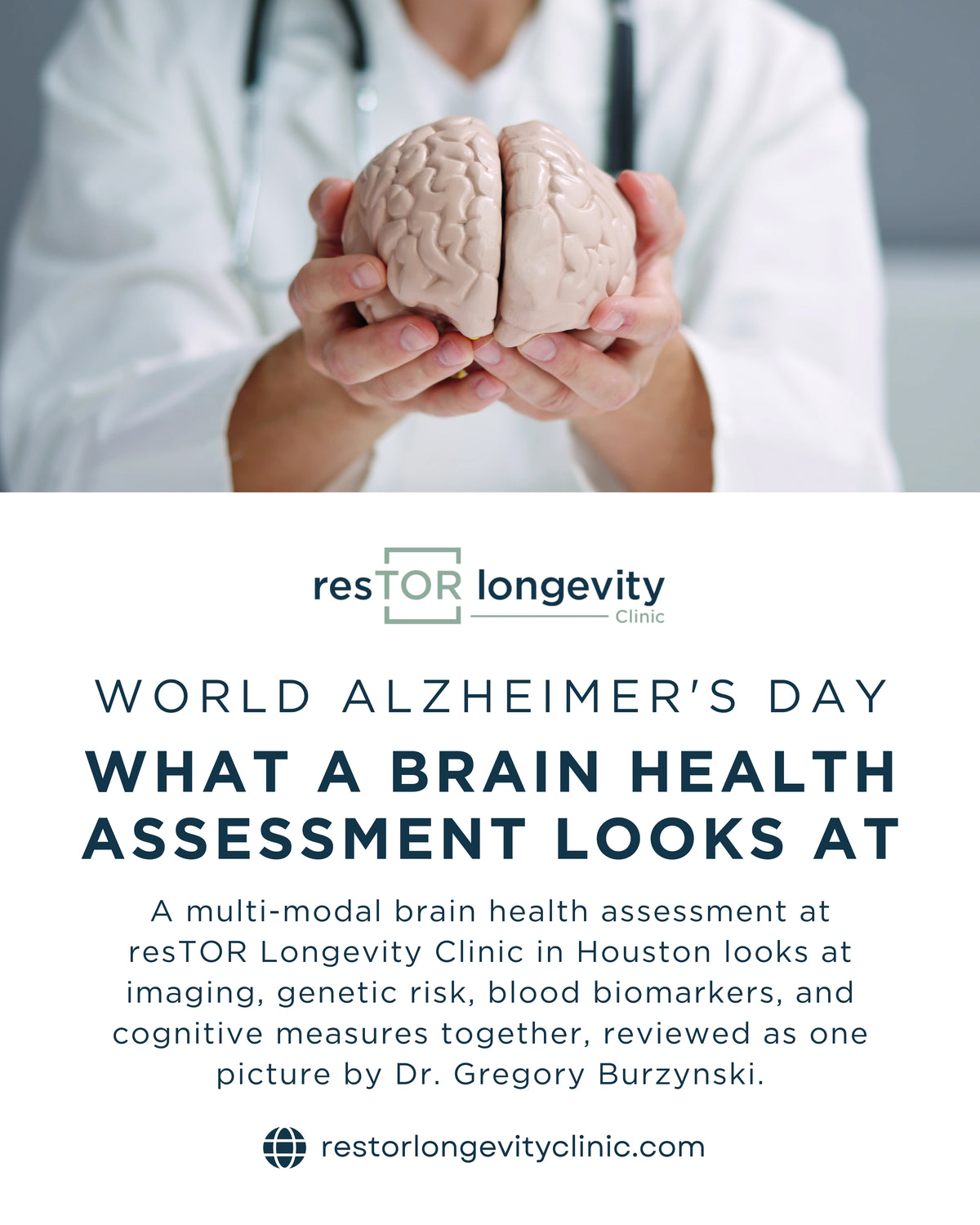
What Does a Brain Health Assessment Look At If Alzheimer's Runs in Your Family?
A multi-modal brain health assessment reviews several independent sources of information together: brain imaging, genetic risk factors, blood biomarkers associated with neurodegenerative change, and cognitive measures. No single one of these is sufficient on its own.
September 21 is World Alzheimer's Day, and at resTOR Longevity Clinic in Houston, Texas, this assessment exists because the changes associated with cognitive decline typically begin well before symptoms appear.
Why Early Assessment Exists At All
Research consistently indicates that the biological processes underlying Alzheimer's disease begin many years, often estimated at two decades, before noticeable memory changes.
That long silent window is the reason assessment is worth doing before anything feels wrong. Once symptoms are apparent, a great deal of the underlying process has already occurred.
Early information does not make anything certain. It creates a longer runway for monitoring and for addressing modifiable contributors.
What Each Layer Contributes
The word multi-modal describes the point. Each component answers a different question, and the value comes from reading them together.
- Imaging provides information about brain structure and volume
- Genetic analysis identifies inherited risk factors relevant to neurological conditions
- Blood biomarkers can indicate early neurodegenerative changes
- Cognitive and functional measures establish a personal performance baseline
A cognitive baseline is often underestimated. Without one, a future test result has nothing meaningful to be compared against.
Risk Factors That Are Actually Modifiable
Genetics is one contributor among several, and a good deal of what influences brain health over time is not fixed.
Cardiovascular health is closely tied to brain health, since the brain depends on the same vascular system as everything else. Blood pressure, lipids, and arterial health all belong in a brain health conversation.
Metabolic health, sleep quality, hearing, physical activity, and social engagement each carry evidence supporting their relevance. Untreated hearing loss in particular is one of the more commonly cited modifiable factors.
None of these guarantees an outcome. They represent the parts of the picture that can be acted upon.
Deciding Whether You Want to Know
The hesitation many people feel about brain health testing is understandable and worth taking seriously rather than arguing away.
It is reasonable to ask what would change based on the results before deciding whether to pursue them. For most patients, the honest answer involves monitoring frequency, cardiovascular and metabolic management, sleep evaluation, and planning horizon.
That conversation belongs before testing, which is why the process begins with a physician consultation rather than a lab order.
Where This Sits in the resTOR Assessment
The multi-modal brain health assessment is part of the Core and Essential programs, reviewed alongside cardiovascular imaging, metabolic markers, sleep evaluation, and hearing screening.
Dr. Gregory Burzynski, MD reviews these layers together during the results consultation described on the resTOR process page. Patients from Memorial, Sugar Land, and across Houston complete testing in a single assessment day.
"Patients with a parent who had dementia often arrive carrying real fear. What helps is not reassurance. It is a baseline, a monitoring schedule, and a list of the things we can genuinely influence," says Dr. Gregory Burzynski, MD.
Frequently Asked Questions
If my parent had Alzheimer's, will I get it?
No. A family history increases risk within a family but does not determine an individual outcome. Many people with a parent who had Alzheimer's never develop it, and many who develop it have no family history. Assessment helps clarify your own risk profile rather than predicting a result.
Is there any point in testing if there is no cure?
Early information can influence monitoring frequency, cardiovascular and metabolic management, sleep and hearing evaluation, and personal planning. Whether that value justifies testing is a personal decision, and it is a reasonable one to discuss with a physician before proceeding.
At what age should brain health assessment begin?
Because the underlying changes can begin decades before symptoms, baseline assessment in midlife is often more useful than waiting. The right timing depends on family history and other risk factors, and is best decided in consultation.
Mark World Alzheimer's Day With a Baseline
If cognitive decline is something your family has lived through, establishing your own baseline is a concrete step. Contact resTOR Longevity Clinic in Houston, Texas to schedule a consultation.
Published by resTOR Longevity Clinic | Dr. Gregory Burzynski | Serving Houston and Harris County, TX | (832) 968-7531
Educational purposes only. Not medical advice.